Engage young writers with relatable stories, differentiated formats, and classroom-ready visuals!

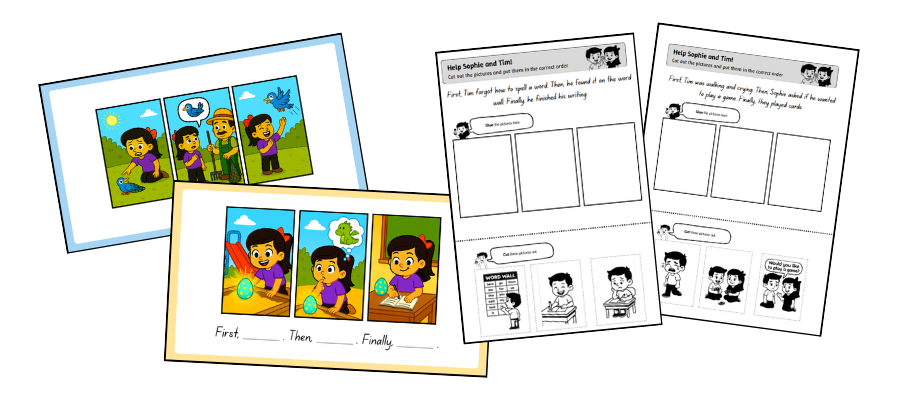
This time-saving resource includes 15 original three-part comic strip narratives starring two lovable primary school characters, Sophie and Tim. It has been designed to spark imagination and support foundational writing skills in early childhood classrooms.

Each comic strip is provided in three flexible formats to suit a range of writing abilities:

  • 🎨 Visual Only – Perfect for oral storytelling, discussion starters, or independent interpretation.
  • 📝 Scaffolded Response – Includes sentence starters to guide emerging writers and build confidence.
  • ✂️ Cut & Paste Story Ordering – A hands-on sequencing task that reinforces narrative structure and comprehension.

Why Teachers Love It:

  • Differentiated for mixed-ability groups – Easily adapt tasks for learners with differing levels of ability.
  • Ready to print or project – No prep required. Just choose your format and go!
  • Builds narrative skills – Students explore characters, settings, and events in a structured, visual way.
  • Relatable characters – Sophie and Tim model everyday experiences, making writing meaningful and fun.

Whether you’re introducing story structure, supporting sentence formation, or encouraging creative thinking, this resource is your go-to toolkit for engaging early writers.
Curriculum Alignment

AC9E1LA03 Year 1, English (Language)
Explore how texts are organised according to their purpose, such as to recount, narrate, express opinion, inform, report and explain.
AC9E1LA07 Year 1, English (Language)
Understand that words can represent people, places and things (nouns, including pronouns), happenings and states (verbs), qualities (adjectives) and details such as when, where and how (adverbs).
AC9E1LY05 Year 1, English (Literacy)
Use comprehension strategies such as visualising, predicting, connecting, summarising and questioning when listening, viewing and reading to build literal and inferred meaning by drawing on vocabulary and growing knowledge of context and text structures.
AC9E1LY06 Year 1, English (Literacy)
Create and re-read to edit short written and/or multimodal texts to report on a topic, express an opinion or recount a real or imagined event, using grammatically correct simple sentences, some topic-specific vocabulary, sentence boundary punctuation and correct spelling of some one- and two-syllable words.
AC9E2LA08 Year 2, English (Language)
Understand that images add to or multiply the meanings of a text.
AC9E2LA09 Year 2, English (Language)
Experiment with and begin to make conscious choices of vocabulary to suit the topic.
AC9E2LY05 Year 2, English (Literacy)
Use comprehension strategies such as visualising, predicting, connecting, summarising, monitoring and questioning to build literal and inferred meaning.
AC9E2LY06 Year 2, English (Literacy)
Create and edit short imaginative, informative and persuasive written and/or multimodal texts for familiar audiences, using text structure appropriate to purpose, simple and compound sentences, noun groups and verb groups, topic-specific vocabulary, simple punctuation and common 2-syllable words.
AC9EFLA03 Foundation, English (Language)
Understand that texts can take many forms such as signs, books and digital texts.
AC9EFLA05 Foundation, English (Language)
Recognise that sentences are key units for expressing ideas.
AC9EFLA07 Foundation, English (Language)
Explore the contribution of images and words to meaning in stories and informative texts.
AC9EFLE02 Foundation, English (Literature)
Respond to stories and share feelings and thoughts about their events and characters.
AC9EFLE03 Foundation, English (Literature)
Recognise different types of literary texts and identify features including events, characters, and beginnings and endings.
AC9EFLY05 Foundation, English (Literacy)
Use comprehension strategies such as visualising, predicting, connecting, summarising and questioning to understand and discuss texts listened to, viewed or read independently.
AC9EFLY06 Foundation, English (Literacy)
Create and participate in shared editing of short written texts to record and report ideas and events using some learnt vocabulary, basic sentence boundary punctuation and spelling some consonant-vowel-consonant words correctly.

Related Resources


© Pedagogy Pioneers 2026